A bolt cutter that is too small for the job won’t close through the material — and forcing it can chip the jaws or bend the head. One that is far too big is heavy and awkward for everyday work. Whether you are equipping a site crew or choosing a range to stock as a distributor, three questions decide the right tool: what are you cutting, how thick is it, and how hard is it.
1. Know what “cutting capacity” means
A bolt cutter is rated by its maximum cutting capacity — the largest diameter of solid material it is designed to cut, such as 8 mm or 1/2″.
Two things to keep in mind:
- The rating applies to the material it was designed for. Capacity figures are normally given for ordinary (mild) steel bolts, rods and chain. Harder material needs more force, so the practical capacity is lower.
- Measure the actual diameter. For a chain, measure the thickness of one link, not the width of the link. For threaded rod and bolts, measure the outside diameter of the thread.
Rule of thumb: choose a cutter whose capacity is equal to or larger than what you cut most often. If your material is right at the limit, go one size up — the cut is easier and the jaws last longer.
2. Bolt cutter size chart
| Cutting capacity | Equivalent | Typical material |
|---|---|---|
| 8 mm | approx. 5/16″ | Light bolts, wire, small chain |
| 3/8″ | 9.5 mm | 3/8″ bolts and threaded rod |
| 10 mm | approx. 3/8″ – 13/32″ | M10 bolts, steel rod, general maintenance |
| 12 mm | approx. 15/32″ | M12 bolts, heavier rod and chain |
| 1/2″ | 12.7 mm | 1/2″ bolts, threaded rod and chain |
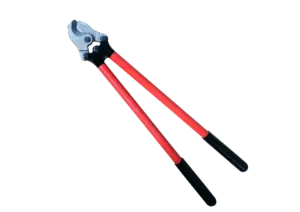
The THK VRC-0913 steel bolt cutter is available in all five capacities above, with a CNC machined SCM440 alloy steel cutting head and a ductile cast iron body. See it on our Special Tools page.
3. Bolt cutter or wire rope cutter?
Bolt cutters and wire rope cutters look similar but cut very differently:
| Bolt cutter | Wire rope cutter | |
|---|---|---|
| Built for | Solid material: bolts, rods, chain | Stranded material: wire rope, stainless wire, electrical cable |
| How it cuts | Two jaws meet and pinch through the steel | Blades wrap around the rope so the strands don’t fray |
| Wrong use | Crushes and frays wire rope | Can chip the blades on solid bolts |
If your crew cuts both wire rope and power cable, a dual-purpose cutter such as the CW400/16 (steel wire rope Ø18 mm, stainless steel wire Ø16 mm, electrical cable 400 mm²) covers both jobs with one tool. For copper and aluminum cable only, see our cable cutters and the guide How to Choose the Right Cable Cutter Size.
4. What about hardened steel?
Padlock shackles, hardened chain and high-tensile bolts are much harder than ordinary steel. Cutting them with a standard bolt cutter can chip or dent the jaws, even when the diameter is within the rated capacity.
If you need to cut hardened material regularly, tell your supplier the material and diameter before ordering. For the VRC-0913, send us the details and we will advise on the right tool.
5. How to cut safely and get a clean cut
- Wear eye protection. Cut ends can fly off when the material snaps.
- Cut at a right angle. Place the material as deep in the jaws as possible, square to the blades.
- Use steady pressure. Squeeze evenly; don’t rock or twist the cutter, which can damage the jaws.
- Don’t extend the handles with pipes or bars — if it won’t cut, the material is too large or too hard for the tool.
- Support the offcut so it doesn’t fall on feet or equipment.
6. Care and replacement heads
- Wipe the jaws clean and apply a light oil to the pivot points after use.
- Check that the jaws meet evenly. A gap or chipped edge means it is time to adjust or replace the head.
- On the VRC-0913, replacement cutting heads are available, so the tool can be repaired instead of replaced.
7. Buying for a store or a brand?
- Cover the common sizes: a smaller capacity (8 mm – 3/8″) for light maintenance and a larger one (12 mm – 1/2″) for heavier work.
- Stock replacement heads for repeat sales.
- Private label: THK can print your logo on the tool and pack to your own carton design. Samples are ready in about 10 days; mass production takes 30 – 45 days.
Contact us for a quotation or download our product catalog.
Frequently Asked Questions
What size bolt cutter do I need for a 3/8″ bolt?
Choose a cutter rated for at least 3/8″ (9.5 mm) — for example the VRC-0913 in 3/8″ or 10 mm. If the bolt is hardened, contact us with the material first.
Can a bolt cutter cut wire rope?
It is not recommended. A bolt cutter crushes and frays wire rope. Use a wire rope cutter such as the CW400/16.
Is bolt cutter capacity the same for all materials?
No. Capacity ratings are for ordinary steel. Harder materials reduce the size a cutter can handle.
Are replacement heads available for the VRC-0913?
Yes. Replacement cutting heads are available for the VRC-0913.
Related guides: Bolt Cutters & Wire Rope Cutters · How to Choose the Right Cable Cutter Size