A good PVC pipe cutter makes a clean, square cut in seconds. The wrong one crushes the pipe, leaves an angled end that won’t seal in the fitting, or simply doesn’t open wide enough. Whether you are buying for your own crew or choosing a range to stock as a distributor, three questions decide the right tool: what size is the pipe, what type of cutter suits the job, and how good is the blade.
1. Measure the outside diameter — not the nominal size
PVC pipe cutters are rated by the maximum outside diameter (O.D.) they can open around. This is where many buyers go wrong, because pipe sizes are named differently around the world:
- Metric PVC and PE pipe is named by its O.D. — a 32 mm pipe really is 32 mm across.
- US Schedule 40 and Schedule 80 PVC uses nominal sizes. A “1-inch” pipe actually measures 33.4 mm (1.315″) outside. Schedule 80 has the same O.D. as Schedule 40, just a thicker wall.
- CTS (copper tube size) CPVC and PEX is also named by nominal size, with an O.D. 1/8″ larger than the name — a 1/2″ CTS pipe is 15.9 mm (0.625″) outside.
Common pipe sizes and their outside diameter
| Pipe | Nominal size | Outside diameter |
|---|---|---|
| CTS CPVC / PEX | 1/2″ | 15.9 mm (0.625″) |
| CTS CPVC / PEX | 3/4″ | 22.2 mm (0.875″) |
| CTS CPVC / PEX | 1″ | 28.6 mm (1.125″) |
| Sch 40 / 80 PVC | 1/2″ | 21.3 mm (0.840″) |
| Sch 40 / 80 PVC | 3/4″ | 26.7 mm (1.050″) |
| Sch 40 / 80 PVC | 1″ | 33.4 mm (1.315″) |
| Sch 40 / 80 PVC | 1-1/4″ | 42.2 mm (1.660″) |
| Sch 40 / 80 PVC | 1-1/2″ | 48.3 mm (1.900″) |
| Sch 40 / 80 PVC | 2″ | 60.3 mm (2.375″) |
| Sch 40 / 80 PVC | 2-1/2″ | 73.0 mm (2.875″) |
| Metric PVC / PE | 20 – 75 mm | Same as the name |
Rule of thumb: choose a cutter whose maximum O.D. is equal to or larger than your pipe’s O.D. If your pipe is right at the limit, go one size up — the cut will be easier and the tool will last longer.
Which THK model fits?
| Max. pipe O.D. | Model | Fits, for example |
|---|---|---|
| 25 mm | VS-25 | 20 / 25 mm metric · 1/2″ and 3/4″ CTS · 1/2″ Sch 40 |
| 42 mm | VM-42 / VM-42ND | 32 / 40 mm metric · 1″ CTS · 3/4″ and 1″ Sch 40 |
| 63 mm | VL-63 | 50 / 63 mm metric · 1-1/4″ to 2″ Sch 40 |
| 75 mm | VXL-75D | 75 mm metric · 2-1/2″ Sch 40 |
See the full range on our Plastic Pipe Cutters page.
2. Ratchet cutter or straight-blade cutter?
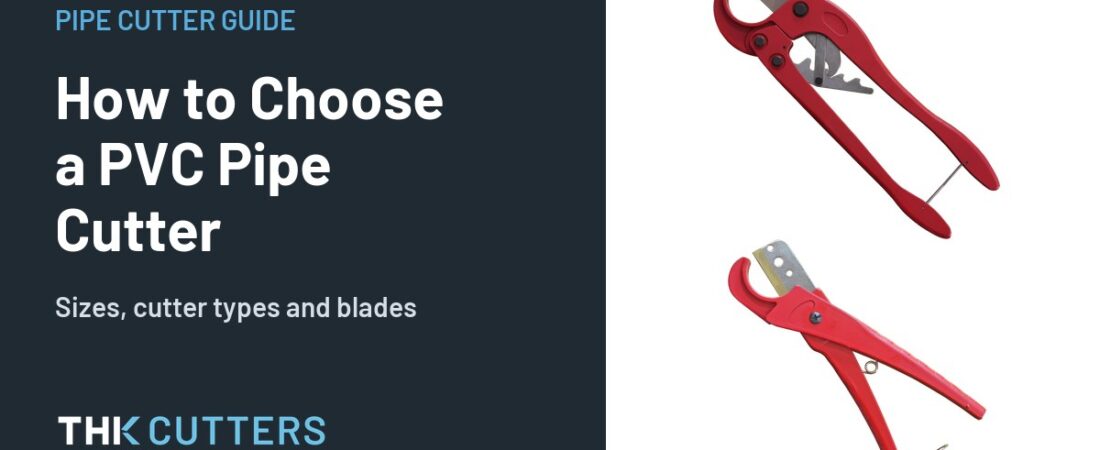
Ratchet pipe cutters (VS-25, VM-42, VM-42ND, VL-63, VXL-75D) advance the blade a little with each squeeze, and the ratchet holds it in place between strokes. They need much less hand force, which makes them the better choice for:
- larger pipe (1-1/4″ / 40 mm and up),
- thick-walled Schedule 80 pipe,
- crews who make many cuts a day.
Straight-blade tube cutters (VS-32P, VS-37A, VS-58P, VS-80P) cut with a direct squeeze of the handles. They are fast and simple for:
- quick, repeated cuts on thinner pipe and tube,
- PEX, PE and rubber hose,
- users who want a light, low-cost tool.
Both types cut PVC, CPVC, PE, PEX, rubber hose and plastic electrical conduit.
3. Look at the blade — it decides the cut quality
The blade is the part that wears, so it is worth checking three things:
- Steel grade. THK cutters use SK5 high-carbon tool steel, which holds a sharp edge through many cuts.
- Blade shape. A standard flat blade suits most pipe. The VM-42ND uses a triangular blade for a sharper cutting action than a standard flat blade.
- Replacement blades. A cutter is only as good as its next blade. Every THK model has a matching replacement blade (model number + “-RBS”), so users can replace the blade instead of buying a new tool — and distributors get repeat sales.
When to replace the blade: when the cutter starts to crush or crack the pipe instead of slicing it, when the cut end is no longer square, or when you see a chip or nick in the edge.
4. How to make a clean, square cut
- Mark the cutting line all the way around the pipe.
- Open the cutter fully and seat the pipe on the support jaw, with the blade on the mark at a right angle to the pipe.
- Squeeze steadily. With a ratchet cutter, release and squeeze again until the blade cuts through.
- Keep the pipe still — don’t twist the cutter, or the cut will be angled.
- Deburr and chamfer the cut end before solvent welding or inserting into a fitting.
In cold weather PVC becomes more brittle; cut slowly and keep the blade sharp to avoid cracking.
5. Buying for a store or a brand?
If you stock PVC cutters for resale, a few extra points matter:
- Cover the common sizes: most stores need a small cutter (up to 25 mm / 3/4″ CTS), a mid-size cutter (up to 42 mm) and a large cutter (63 – 75 mm).
- Stock replacement blades next to the cutters — blades turn over faster than tools.
- Packaging: blister cards and clamshells sell best on a hook; cartons and white boxes suit wholesale.
- Private label: THK can print your logo on the tool and pack the cutters and blades in your own blister cards or boxes. Samples are ready in about 10 days.
Contact us for a quotation or download our product catalog.
Frequently Asked Questions
What size PVC cutter do I need for 1-inch Schedule 40 pipe?
A 1″ Schedule 40 pipe is 33.4 mm outside, so choose a cutter rated for at least 34 mm — for example the VM-42 (up to 42 mm).
Can a PVC pipe cutter cut PEX?
Yes. Both ratchet and straight-blade plastic pipe cutters cut PEX cleanly. Choose the model by the PEX tube’s outside diameter.
Can I use a PVC cutter on metal pipe?
No. PVC cutters are designed for plastic pipe only. Cutting copper, steel or aluminum pipe will damage the blade.
How long does a PVC cutter blade last?
It depends on the pipe size, wall thickness and how often the tool is used. Replace the blade as soon as the cut is no longer clean — a sharp blade is faster and safer.
Related guides: Plastic Pipe Cutters & PVC Cutters · How to Choose the Right Cable Cutter Size